
Create A Skate

There’s a certain hesitation that I used to have with sharing information with others. Long story short, people have taken credit for my work, been promoted over me for work that wasn’t theirs, and have taught homeschool classes with my curriculum and projects without any credit or compensation.
After reading an inspiring article from Christopher Schwarz (The Black (No, Red!) Book of Chairmaking), I started to relax. Which is good for the ol’ heart.
Sooo…. Here’s something for free.
I learned quickly as a shop teacher that teenagers aren’t fond of making bird houses. (Which was disappointing because they sold like hot cakes to the older teachers.) Or really, they’ll suffer through making one, but that’s it. It was me and only a couple of students who finished making them. I made it my goal to projects that connected better with my students, regardless of how well they sold.
By circumstance, I was in the local skate shop talking to the owner about making a longboard for my daughter. He wasn’t into that style but he offered the best advice he could. When I mentioned that I was a shop teacher, he got really excited, telling me about this “Professor” Schmitt who owns one of the biggest skateboarding manufacturers in the US, PS Stix.
“Josiah, you have to check out his Create A Skate program. He has blanks for students to design, cut out, and create their own skateboard.”
I was intrigued and then hooked.
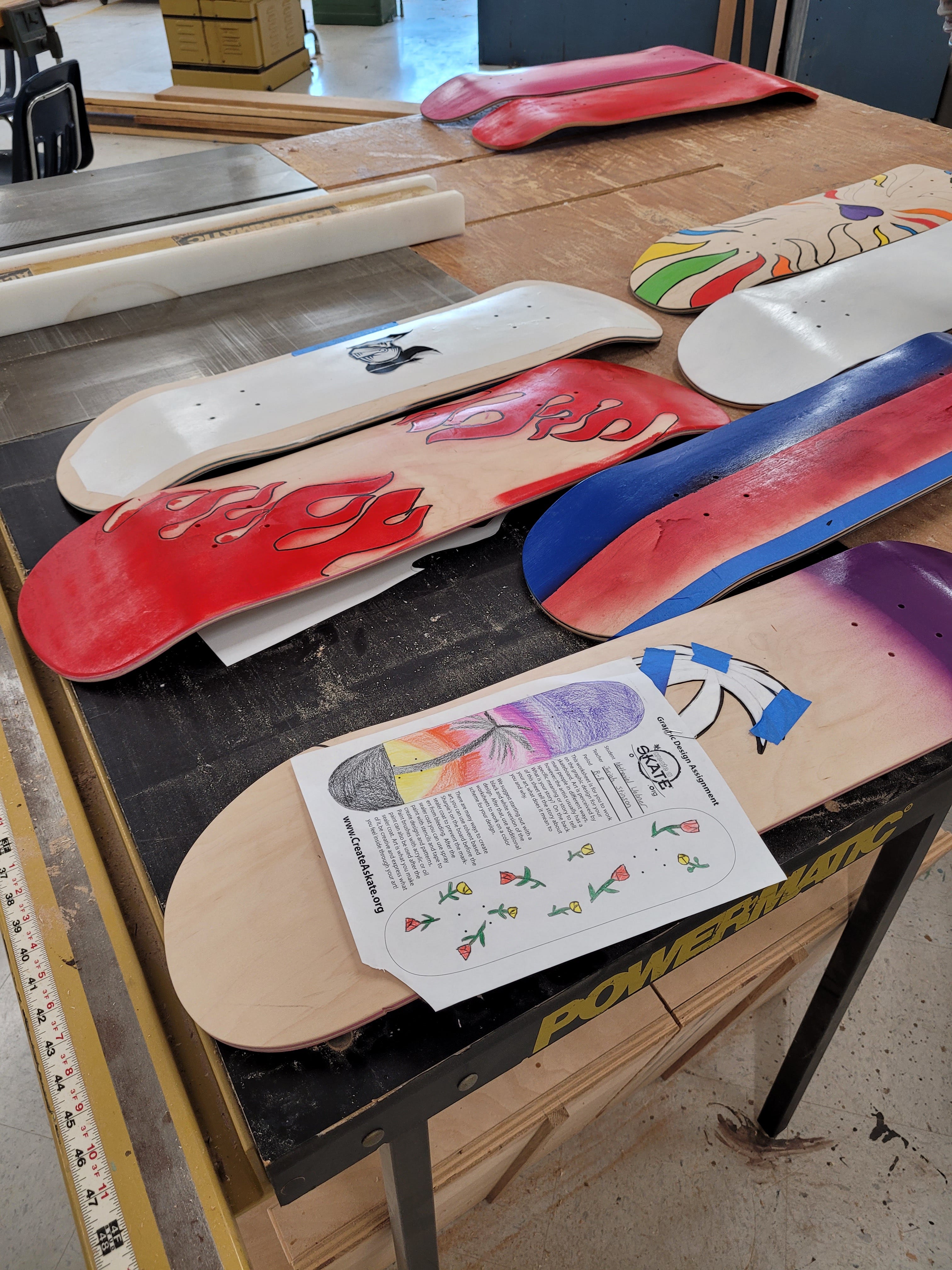
We sold cutting boards to fund the skateboards (which are about $20 a piece) and created a bit of an uproar in the county as we were the only shop class doing stuff like this (out of the five area high schools). We got pictures in the paper. We got mentioned on a radio show out of DC. We got students involved and made some cool boards.
What do I know about skateboards? Now? Actually, a decent amount. Then? Not much at all.
Is it traditional woodworking? Nope, not at all. But do you understand why skateboards are made out of veneer ply? How many layers are in a traditional skateboard? What wood is used for skateboards? By the end of the project, my students could answer all of those questions (without AI) and more. Professor Schmitt not only supplied the board blanks, he also helped to create a curriculum around the making of skateboards.
We also took the skateboard projects and applied it to the Manufacturing Systems I VDOE curriculum. We talked about environmental conscience practices. The students came up with business names, logos, mission statements, t-shirt designs, and other activities as we worked on the boards.
After cutting them out, I allowed students to create logos and paint their boards. What high school student doesn’t like spray paint? I had some really talented and artistic students. The rest of us used stencils.
Not every student enjoyed every facet of the project, but we had maximum participation with it. One of the things that I enjoyed the most was that it gave me a chance to highlight a couple of students who struggled with the academic stuff but excelled in the shop. I gave CK the responsibility to help guide students in his class with cutting out their boards on the bandsaw. It was his picture in the paper that was included in the writeup. It was a good moment for him.
It was interesting to see how it opened students’ eyes to the business side of life. Many of them had just started paying attention to finances. How much should you charge for your services? How much does it take to rent a space in the area? It led to some good discussions.
Whether or not you decide to use this project, it’s a reminder that we have greater participation when we connect projects to our students. It can be tricky with teenagers since interest varies, but that’s okay. I try not to have too much going on at once in the shop with 20 students, but sometimes it’s necessary to have a couple of projects going on or at least a couple of variations of the same project.
Also explore longboards. The analogy that I give to people is that they’re long, narrow cutting boards on wheels…
Let me know what you think of this project and if there’s anything I can do to help you if you’re interested in it.

Fantastic idea. It sounds like it really helped some of your students engage and hopefully reminded some folks how great shop class is.
It is unfortunate that folks have run away with your ideas. My hope is that if others run with this idea it will at least help get a few more kids engaged with shop class and get them thinking about how they could get into the trades in a way that aligns with their interests.
It really was a fun project.
Yeah... I was a little sad. I had spent hours working on that curriculum to have it "borrowed". I don't mind sharing projects or helping people develop curriculum but don't steal mine.